
How to estimate a release deadline
Time estimates fail when complexity and availability shift. Learn how story points, shared estimates and velocity make release dates predictable.

An important part of project management is estimating a project's release date. But how do you predict when a large, complex system will be delivered?
The estimation problems
To deliver on time, you need a reliable estimate of the work. Estimating tasks is usually difficult, especially when you must commit to time-based estimates for each task. Psychologically, committing to a completion time is hard, and those commitments often fail.
The problem with time
Estimating time is problematic for a simple reason: the more complex the task, the greater the chance of missing the deadline. It also depends on who picks up the task. Team members work at different speeds and deliver different amounts of work. Because availability changes with vacations and training, a task estimated by the fastest team member may end up with the slowest. The neat Gantt chart turns into a mess: tasks become overdue, and managers constantly worry whether the project will finish in time.
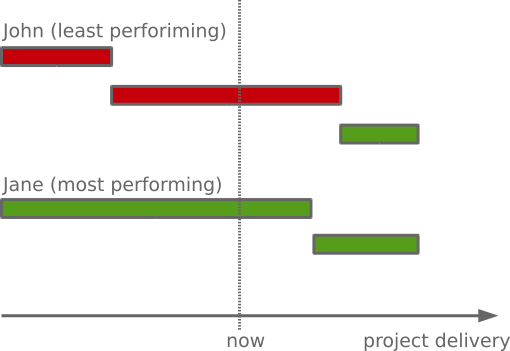
Broken Gantt chart
The resistance against time estimates
When implementers are asked for an estimate, they often resist: if the estimate is missed, who is to blame? And if a task estimated by one person ends up with someone else, who is blamed when the actual time differs?
The result is reluctance to estimate at all, which makes it difficult for management to estimate delivery dates properly.
Using story points
Story points offer an alternative to time-based estimates. A story point is not a fixed unit of work; it is a relative estimate that grows exponentially. The whole team estimates together during refinement.

Example estimates
Sharing responsibility
With story points, the whole team estimates each task. The estimate is accepted when everyone agrees on it. That avoids later arguments about who estimated the task and how long it really took. The team agreed up front, so responsibility is shared.
Estimating complexity
Story points capture the complexity of a task, including its external dependencies and the risk that something might go wrong. Because they are not a commitment to a physical metric like time, they are easier for the team to give.
The smallest estimate
Because story points are relative, you need an anchor to start from. The anchor is the smallest unit of work that requires some implementation effort. It is the smallest amount of work the team can estimate.

The lowest estimate
The biggest estimate
Story points grow exponentially to show that the more complex a task is, the harder it is to estimate. The scale can extend to infinity (∞), though that estimate is rarely used. The largest estimate should be the most work one person can complete in a sprint on average. The sprint length itself should match the largest amount of work one person can handle without losing control of the task.
The stories that are bigger than the biggest estimate
Some tasks receive more story points than one person can complete in a sprint. Putting them in a sprint causes carry-over. Carry-over makes the sprint feel incomplete and the work feel unfinished. Tasks estimated above that limit must be split into smaller units and estimated again.
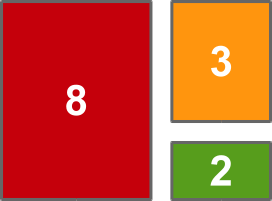
Splitting 13 story points
The story points velocity
Velocity is the average number of story points a team completes in a sprint at full availability. Availability is the share of the sprint the team can actually spend on project work after vacations, training and support. Capacity is velocity multiplied by availability.
capacity = velocity × availability
Because capacity is expressed in story points, it can be converted into time using the team's story-point-to-time ratio. When velocity is predictable, the release date can be estimated precisely. Based on story points and sprints, the resulting Gantt chart is stable and predictable:
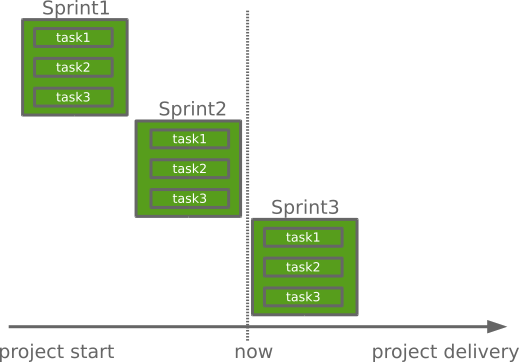
Fixed Gantt chart
That is the shift: once velocity is stable, the release date becomes a calculation rather than a guess.
Related articles
- Managing sprint dependencies with chained pull requestsDependent tickets stall a sprint while people wait. Learn how stacked pull requests keep work moving and reduce idle time.
- Comparison metrics for agile teamsMetrics should create equal ground, not a leaderboard. Four comparison metrics that motivate agile teams without punishing them.
- Sheepherding story pointsOpen votes let the first estimate anchor the room. See how the sheep effect skews story points and how to run planning poker honestly.
About AELBOX
AELBOX is the team behind Scrumpy Planning Poker for Jira. We write about agile estimation, sprint planning and delivery.